.
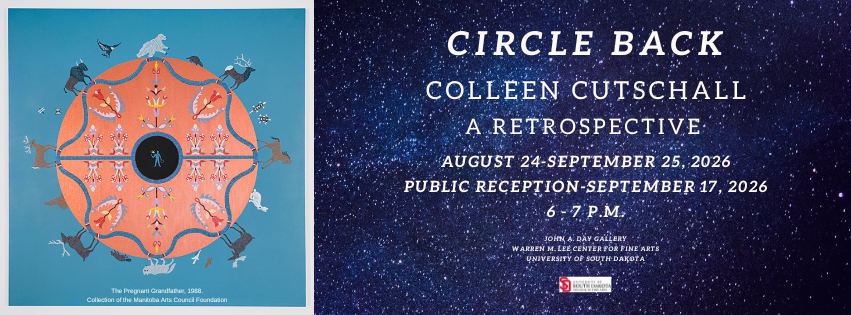
Circle Back
Colleen Cutschall Retrospective
Curated by Dr. Stacey Koosel
August 24 - September 25, 2026
University of South Dakota Art Galleries
Oglala-Sicangu Lakota artist Colleen Cutschall opens her first retrospective exhibition at the University of South Dakota Galleries with over 140 artworks that span 59 years of her professional career. Colleen Cutschall was born on the Pine Ridge Reservation in South Dakota in 1951 to Geraldine Mae Sherman (Cante Waste Win) and Calvin T. Cutschall. Colleen’s mother was an award-winning fashion designer who was considered by many a trail blazer; she ran Contemporary Lakota Fashions by Geraldine Sherman. Colleen would follow in her mother’s footsteps with her own creative practice in contemporary art with paintings, drawings, photography, prints, installation art, public monuments and sculptures that would span her career. Her earliest work included in the show is from 1967, a watercolor painting Black Hills en plein air (1967) painted as a gift to her brother Dennis to comfort and remind him of home while he was stationed in Vietnam, a gift that hangs on the walls of his home to this day.
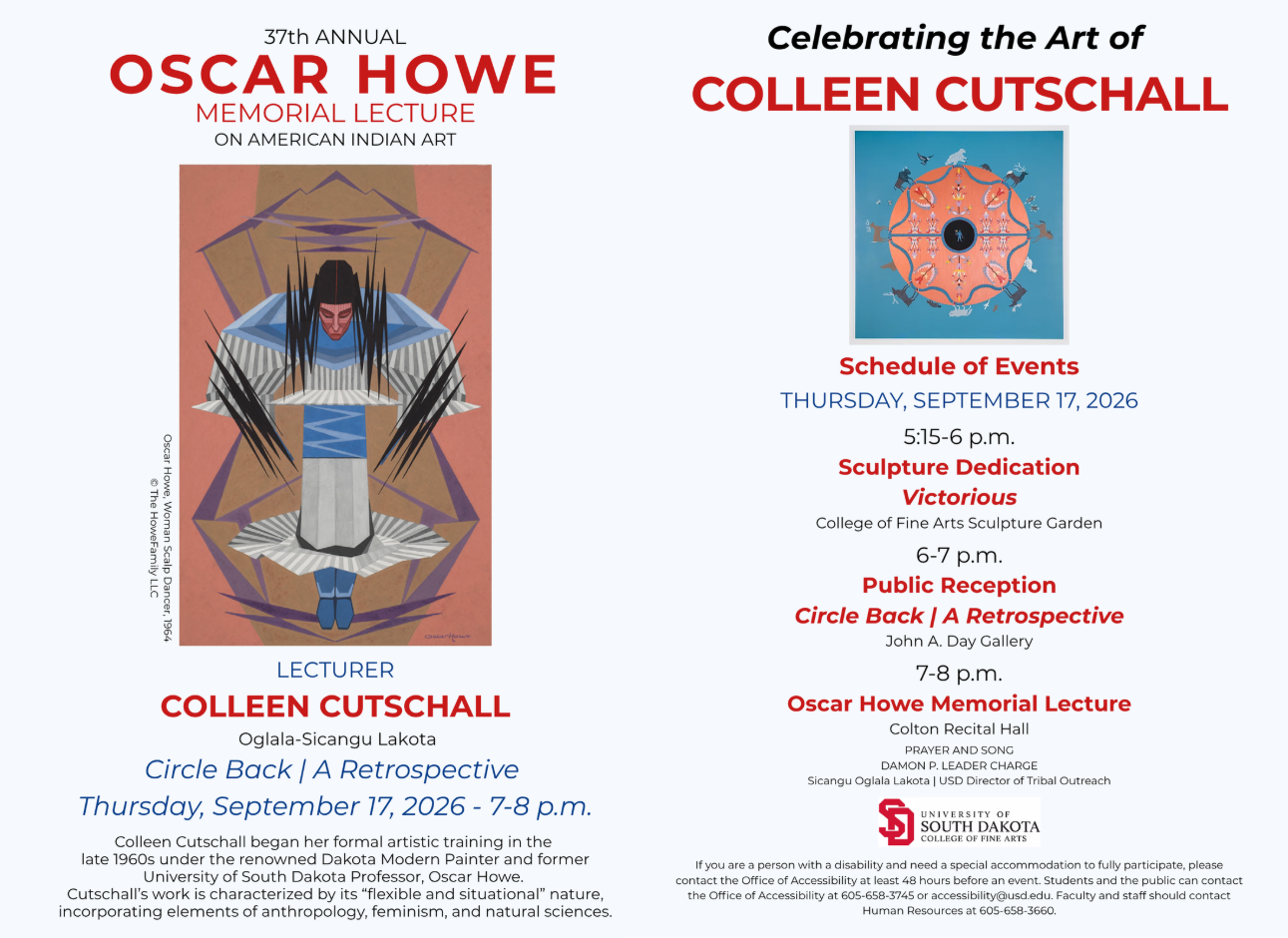
Her most recent artwork, Victorious (2026), is a public artwork commissioned by the University of South Dakota on permanent display at the sculpture garden on campus. The work speaks to Colleen Cutschall’s artistic lineage, and her teacher acclaimed Dakota Modernist painter Oscar Howe (Yanktonai). She attended the ‘Oscar Howe Indian Art Workshop’ in Vermillion, South Dakota in 1967, and a workshop for teachers in 1968 at what is now Black Hills State University. Victorious is a steel sculpture based on Oscar Howe’s 1968 painting Woman Scalp Dancer, Cutschall followed Howe’s path as a Lakota artist who also celebrates her rich cultural heritage in her artwork, and became an educator, and university professor, much like Oscar Howe who taught at the University of South Dakota from 1953 - 1983.
Cutschall researched and developed the curriculum for Standing Rock Community College, in Fort Yates, North Dakota, in 1980-81 with her colleague and fellow Oglala Lakota artist, Arthur Amiotte (Waŋblí Ta Hóčhoka Wašté or Good Eagle Center). Arthur Amiotte also played a pivotal role in Cutschall’s education, she studied and participated in Lakota ceremonies from 1981 - 1988 under Amiotte’s mentorship and worked with his school curriculum ‘Art and Indian Children of the Dakotas’ which was piloted in 1974-76. Captured, forever young in a brilliant purple blazer, Arthur Amiotte (1989), his portrait hangs in this show, among Cutschall’s early figurative works.
In 1985 Cutschall moved to work at Brandon University in Manitoba, Canada and succeeded Amiotte as a professor at the Native Studies Departments, one of the first to be established in Canada. Cutschall would go on to found the Department of Aboriginal and Visual Arts at Brandon University. Creating a space for future Indigenous artists, curators and students - including myself. Cutschall’s retrospective speaks to her Lakota art lineages, how she was Oscar Howe’s student and would go on to inspire future generations of artists, through her career as an artist, researcher and educator.